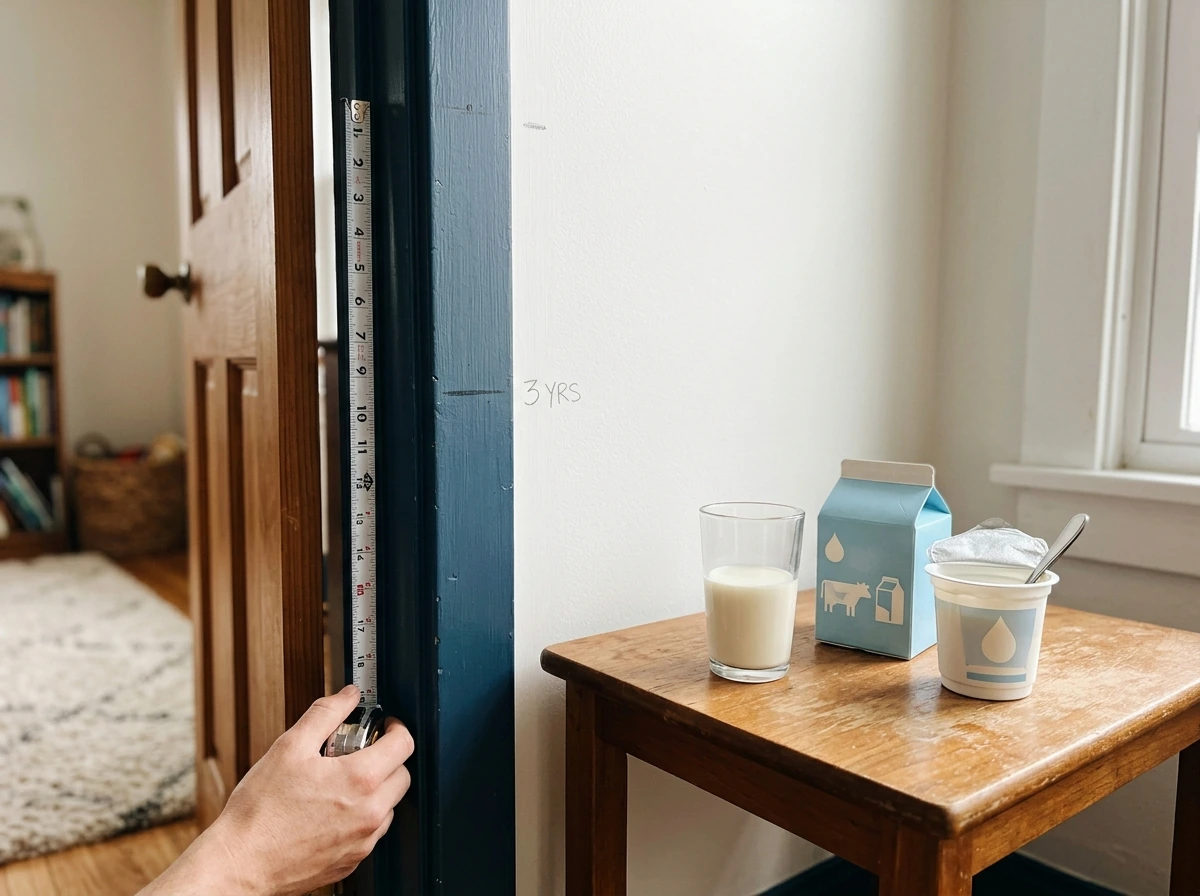
A systematic review of controlled trials in children and adolescents found that dairy supplementation significantly increases bone mineral content, but the evidence for actual height gains is not conclusive. A separate USDA nutrition evidence review reached a similar conclusion: there simply is not enough high-quality, consistent data to say that drinking more milk directly makes older children or adolescents meaningfully taller. That does not mean milk is useless for growth. It means it is one piece of a much larger puzzle.
How milk supports height (and why it still can't override genetics)
Milk's case for supporting growth comes from four main nutrients. Each one plays a real, documented role in how your skeleton develops.
Calcium
Calcium is the primary mineral in bone. Kids aged 9 to 18 need 1,300 mg per day, which is more than at any other life stage because this is when peak bone mass is being built. A cup of milk delivers roughly 300 mg regardless of fat content (whole, reduced-fat, and nonfat milk all contain about the same amount of calcium per serving). That means three cups a day covers most of the daily target for a teenager.
Vitamin D
Vitamin D helps the body absorb and use calcium. Without enough of it, calcium intake becomes far less effective. Most fortified milk in the US provides around 100 IU per cup, and the RDA across childhood and adolescence is 600 IU per day. That means milk alone won't cover your vitamin D needs, but it contributes meaningfully when combined with sunlight exposure and other dietary sources.
Protein
Milk contains high-quality protein including whey and casein, both of which support muscle and tissue growth. More relevant to height, milk consumption is associated with higher circulating levels of insulin-like growth factor 1 (IGF-1), a hormone that plays a direct role in bone and cartilage growth. A randomized controlled trial in 9 to 11-year-old children found that drinking 710 mL of whole milk daily influenced variables on the somatotropic (growth hormone) axis. The IGF-1 connection is biologically plausible and worth taking seriously, even if final height gains from it are hard to isolate.
Total calories
Chronic undernutrition during childhood is one of the clearest causes of stunted growth globally. Milk adds calories and macronutrients in a relatively convenient package, so in contexts where kids are not eating enough overall, adding milk can meaningfully support growth. In well-nourished populations where calories are not scarce, the additional benefit shrinks.
The genetics ceiling
Genetics set the upper bound. Your height potential is largely determined by your parents' heights and your hormonal profile during puberty. No single food, including milk, changes that ceiling. What nutrition does is help you reach it, not exceed it. Think of it like fuel in a car: the right fuel helps you get where you are going, but it does not change how far the road goes.
Puberty vs after puberty: when milk can and can't make a difference

This is where life stage matters enormously, and it is worth understanding the biology before setting any expectations.
Height increases happen because of growth plates, also called epiphyseal plates. These are areas of cartilage near the ends of long bones where new bone tissue is produced through a process called endochondral ossification. As long as those plates are open and active, your body can grow taller with proper nutrition and hormonal support. Once they fuse and turn to solid bone, that is it. No amount of milk, calcium, or any other nutrient can reopen them.
The timing of growth plate fusion varies more than most people realize. An MRI study of 958 adolescents found that complete fusion occurs roughly two years earlier in girls than in boys. Fusion in the distal tibia and fibula can be complete as early as age 14 in some males and 16 in other groups, with significant variation by sex and ancestry. Estrogen, which rises sharply during female puberty, accelerates growth plate senescence and fusion, which is why girls often stop growing earlier despite their earlier puberty onset.
What this means practically: during pre-puberty and puberty, good nutrition including adequate milk intake can genuinely support your growth trajectory and help you reach closer to your maximum height. A prospective cohort study in adolescent girls found associations between dairy intake and peak height growth velocity. That is real, meaningful evidence that dairy during this window matters. After growth plates fuse, which typically happens in the late teens but can vary widely, no dietary strategy will add height. Adults who are still consuming milk for bone health are doing something useful for bone density, not for getting taller.
Warm milk before bed: does timing actually matter for growth?
The idea that warm milk before bed helps you grow is popular, but the evidence directly linking it to height is essentially nonexistent. Here is what we do know: growth hormone is secreted in pulses, with the largest pulse occurring during deep sleep, particularly in the early hours of the night. Sleep quality and duration genuinely matter for growth hormone output. If warm milk helps you sleep better (some research suggests milk intake is associated with longer sleep duration in young children), then there could be an indirect benefit, but this chain of reasoning is a stretch, not a proven mechanism.
One study evaluated milk given as a bedtime snack and looked at sleep parameters and biochemical markers in people with insomnia, but it was not studying height. Another conference abstract noted an association between milk intake and sleep duration in first-graders and called for more research on timing. No study has directly tested warm bedtime milk against height outcomes. The warm part specifically has no evidence behind it at all when it comes to growth.
The practical takeaway: if you want to drink milk before bed, go ahead. It provides protein and calcium, and if it helps you wind down, the sleep quality benefit is real. But drinking it cold during the day works just as well for the nutrients your bones need. Do not stress about the timing or temperature.
Which milk is actually best for growth support?

People search for the "best" milk for getting taller, and the honest answer is that the differences between types are smaller than the marketing suggests. Here is a straightforward comparison across the options most people consider:
| Milk Type | Calcium per Cup | Protein per Cup | Key Notes |
|---|
| Whole milk | ~300 mg | ~8 g | Higher calories and fat; good for kids who need extra energy; same calcium as lower-fat options |
| Reduced-fat (2%) | ~300 mg | ~8 g | Middle ground on calories; no meaningful bone-nutrient advantage over whole |
| Nonfat (skim) | ~300 mg | ~8 g | Lowest calories; same calcium and protein; may have slightly less fat-soluble vitamin absorption |
| Lactose-free milk | ~300 mg | ~8 g | Nutritionally identical to regular milk; enzyme-treated to break down lactose; no height advantage beyond fixing a tolerance barrier |
| Fortified plant milks (soy) | ~300 mg (if fortified) | ~7–8 g (soy) | Soy milk is the closest plant-based equivalent in protein; other plant milks often have much less protein and vary widely in fortification |
The fat content of milk does not meaningfully change its calcium content. Pediatric guidance is clear on this point: nonfat, reduced-fat, and whole milk all deliver roughly the same calcium per cup. What changes with fat content is calories and the delivery of fat-soluble vitamins like vitamin D and A. For younger children who need more calories for energy and growth, whole milk is often recommended. For older kids and teens with adequate calorie intake, any version of cow's milk hits the same mineral targets.
Lactose-free milk is nutritionally identical to regular milk. If someone avoids milk due to lactose intolerance and switches to lactose-free, they get the same calcium, protein, and vitamin D. The height equation does not change. Research on lactase persistence (the genetic ability to digest lactose) and height in Swedish youth suggests that people who tolerate milk are more likely to drink it regularly, which may partly explain why milk drinkers tend to be taller on average. But the nutrient content, not the lactose, is doing the work.
For anyone curious about whether flavored milks like [strawberry milk](DAF8654E-1E18-465B-B8E0-483C2601724A) or specific milk varieties change the growth equation, the core nutrients remain similar, though flavored milks often add significant sugar. That is worth factoring into daily diet quality even if it does not directly impact bone nutrients.
How much milk to drink, and when
Concrete targets are more useful than vague advice to "drink more milk." Here is what the evidence and dietary guidelines actually recommend by age group:
| Age Group | Dairy Recommendation (cups/day) | Calcium RDA | Practical Notes |
|---|
| Children 1–3 years | 2 cups/day | 700 mg/day | Whole milk typically recommended; solid foods also contribute calcium |
| Children 4–8 years | 2.5 cups/day | 1,000 mg/day | Each cup provides ~300 mg calcium; 2.5 cups covers most of the RDA |
| Adolescents 9–18 years | 3 cups/day | 1,300 mg/day | This is the highest-need stage; 3 cups covers ~900 mg, so other dietary sources matter too |
| Adults 19–50 years | 3 cups/day | 1,000 mg/day | Useful for bone density maintenance; growth plates are fused, so height is unaffected |
A 2025 consensus statement from key national health and nutrition organizations recommends plain pasteurized milk as part of a healthy diet for school-age children and adolescents aged 5 to 18. Three cups per day for teens is the consistent recommendation, and it aligns with the calcium RDA for that age group when combined with other dietary calcium sources like cheese, yogurt, leafy greens, or fortified foods.
Spreading intake across the day rather than drinking it all at once is the more practical approach. Calcium absorption is more efficient in smaller doses, so having milk with breakfast, lunch, and dinner (or as a snack) is better than three glasses back to back. If you prefer drinking milk before bed, that serving counts toward your daily total just as well as any other time.
Does Muscle Milk or milk protein powder actually affect height?

This comes up a lot, particularly from teens who are also interested in fitness. The short answer is no, milk protein supplements do not have meaningful evidence behind them for increasing height.
A randomized controlled trial that tested milk protein drinks in overweight adolescents found no difference in height or height Z-scores compared to the water control group. That is a direct test of milk protein supplementation on linear growth, and it came up empty. Separately, a trial on milk protein and resistance exercise in middle-aged and older adults measured improvements in muscle mass and strength, but not height, because height is simply not a realistic endpoint in adults.
Products like Muscle Milk are protein supplements designed primarily for muscle recovery and hypertrophy. They contain whey or casein protein (milk-derived), and while protein is one of the nutrients that supports growth, adding extra protein on top of an already adequate diet does not appear to translate into additional height. The growth-limiting factor in a well-nourished adolescent is not protein scarcity, it is the biology of growth plate activity and hormonal signaling.
There is also a safety consideration worth mentioning. Protein supplements are not regulated like food or medicine, and pediatric nutrition guidance consistently emphasizes that supplements should not replace the overall nutrient balance of a complete diet. If a teen is eating adequate calories and protein from food, layering protein powders on top adds calories without meaningful growth benefit and may displace other important nutrients.
Practical next steps to maximize your height potential
If you are still in your growing years, the most useful thing you can do is treat height optimization as a whole-system project, not a single-food fix. Here is what actually moves the needle:
Get your calcium and vitamin D consistently

Three cups of milk per day (or equivalent dairy) hits your calcium target during adolescence, but vitamin D is the nutrient many kids and teens are quietly deficient in. The RDA is 600 IU per day across childhood and adolescence. Fortified milk contributes around 300 IU from three cups, so sunlight exposure (15 to 30 minutes of midday sun on bare skin several times a week) and potentially a vitamin D supplement fill the gap. A simple blood test can confirm whether your levels are adequate.
Prioritize sleep
Growth hormone secretion peaks during deep sleep. Teenagers need 8 to 10 hours per night, and consistently falling short of that compresses the window in which growth hormone does its work. This is arguably as important as any nutrient during puberty. Consistent sleep timing (same bedtime and wake time) supports deeper, more restorative sleep cycles.
Eat a complete, varied diet
Milk is one source of growth-supporting nutrients, not the only one. Lean proteins, zinc (found in meat, legumes, and seeds), vitamin A, and overall adequate calories all contribute to reaching your height potential. Chronic calorie restriction during puberty is one of the clearest ways to limit growth. Make sure total food intake is sufficient, not just calcium.
Stay physically active
Weight-bearing and resistance exercise stimulates bone formation and supports healthy IGF-1 signaling. Activities like running, jumping sports, and resistance training all stress bones in ways that promote density and development. Exercise is not going to make you taller than your genetics allow, but it supports the hormonal environment that keeps growth plates active during puberty.
Know when to talk to a doctor
If a child or teen is falling below the 3rd height percentile on growth charts, crossing downward percentile lines, or not growing at the expected rate for their age, that warrants a clinical evaluation, not just more milk. Pediatric endocrinologists use bone age X-rays, growth charts, and lab work to distinguish between normal variation and treatable growth issues like growth hormone deficiency or conditions affecting the growth plates. Rickets (caused by severe vitamin D and calcium deficiency) is one direct example of a nutritional deficiency that impairs growth plate function and causes pathological growth failure. Addressing deficiency corrects growth plate pathology; simply adding milk to an already adequate diet does not.
If you are an adult asking whether you can still grow taller by drinking milk, the honest answer is almost certainly no. Once growth plates have fused, which is confirmed by bone age imaging, additional calcium and protein support bone health but cannot restart longitudinal growth. The right goal at that stage is protecting the bone density you have, not chasing height.
The bottom line: milk is genuinely useful nutritional support during the years when growth is happening. Three cups a day during adolescence, combined with adequate sleep, overall good nutrition, regular physical activity, and vitamin D from sun and other sources, gives your body the best realistic environment to reach its programmed height. That is a meaningful contribution, even if it is not the magic growth potion the old ads suggested.